
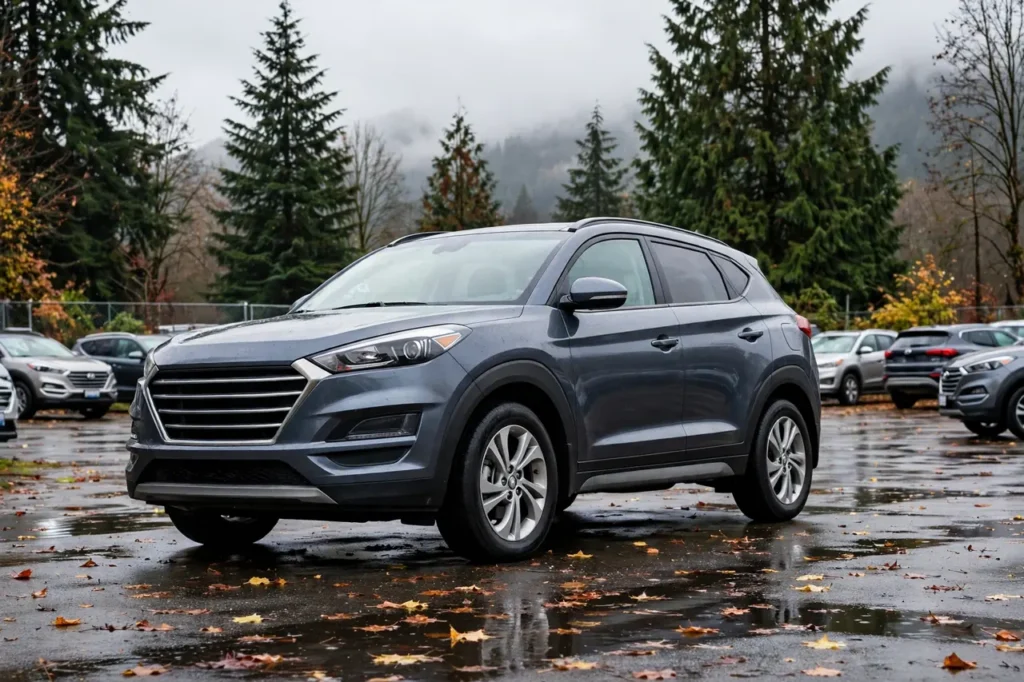
Used Hyundai Tucson Buyer’s Guide for BC: Generations, Engines, AWD and What to Check
The Hyundai Tucson is the compact SUV that quietly undercuts its famous rivals. A used Hyundai Tucson in BC usually costs less than a comparable Honda CR-V or Toyota RAV4 of the same year, yet the third-generation Tucson (2016–2021) offers the same five-seat, all-wheel-drive formula Lower Mainland families actually use. The catch: this generation sold with three different engines and two very different transmissions, so the individual car matters more than the badge. This guide covers the generations, engines, fuel ratings and the checks that separate a good used Tucson from a disappointing one — with a live Langley example to make it concrete.
Why the Tucson makes sense as a used buy in BC
The Tucson sits on the smaller, easier-to-park side of the compact SUV class, which suits Langley and Surrey driving: tight parking lots, Highway 1 commuting and Fraser Valley weekend trips. Cargo space is honest — about 878 litres behind the rear seats and 1,753 litres folded, on the third generation’s published specifications. Mid-trim Tucsons were also equipped generously for the price, so used examples often carry heated seats and a backup camera that cost extra on rivals. Because the Tucson lacks the RAV4’s resale premium, your budget reaches a newer or lower-kilometre vehicle — provided you choose the right powertrain and verify the car’s history.
Tucson generations explained
First and second generations (2005–2015)
The original Tucson (2005–2009) was a simple, value-priced compact SUV; the sleeker 2010–2015 redesign (the ix35 in some markets) is now old enough that condition and maintenance history matter more than trim. Most BC buyers today should start with the third generation.
Third generation (2016–2021)
The 2016 redesign is the Tucson sweet spot. It grew over its predecessor, with a stiffer body, a quieter cabin and more cargo room, and ran through 2021 with one significant mid-cycle change: a 2019 refresh that replaced the turbo engine with a larger non-turbo engine, put a conventional six-speed automatic in every model, and made forward collision avoidance and lane-keeping assist standard.
Fourth generation (2022–present)
The current Tucson is larger again, with the nameplate’s first hybrid and plug-in hybrid versions — excellent, but nearly-new pricing puts it in a different conversation from the used examples most buyers cross-shop.
Engines and transmissions: the decision that defines a used Tucson
- 2.0L four-cylinder, 164 hp and 151 lb-ft — the base engine for the whole third generation, paired with a conventional six-speed automatic. Natural Resources Canada rated the 2016 AWD version at 11.0 L/100 km city, 9.0 highway and 10.1 combined (front-wheel drive: 9.0 combined). It is not quick, but it is the simplest, most predictable powertrain in the range — and the one in our Langley example below.
- 1.6L turbocharged four-cylinder, 175 hp and 195 lb-ft (2016–2018) — stronger and, on paper, more economical: rated 9.2 L/100 km combined with standard AWD. The trade-off is its seven-speed dual-clutch transmission, which can hesitate at low speeds in stop-and-go traffic. On a test drive, creep slowly, reverse gently and pull away repeatedly; a healthy example behaves consistently. If low-speed manners feel uneven, budget for diagnosis or choose the 2.0L.
- 2.4L four-cylinder, 181 hp and 175 lb-ft (2019–2021) — the refresh engine that replaced the turbo, again with the six-speed automatic, rated about 10.1 L/100 km combined with AWD. For buyers who want the newest third-generation cars, this is the straightforward choice: more power than the 2.0L, no dual-clutch question.
All-wheel drive was available on most trims and standard on higher ones. For BC it is worth having for ski trips and unploughed side streets — but as the winter section explains, tires matter more than the drivetrain badge.
A live Langley example, and the rivals beside it
At WG Motors in Langley today, our Tucson is a 2016 Hyundai Tucson Luxury priced at $9,900 with 96,000 km — low kilometres for its year. It uses the 2.0L engine, six-speed automatic and all-wheel drive. It carries a rebuilt title: its listing states plainly that the car had previous body damage, has been repaired and is ready to drive, and we disclose that here exactly as on the car itself. As a worked example of the all-in cost, $9,900 plus our $499 documentation fee is $10,399; at the 12% combined GST and PST on a dealer passenger vehicle under $55,000 in BC, tax is $1,247.88, for an all-in total of $11,646.88 before insurance.
Cross-shopping the same lot shows what the Tucson’s value buys. The 2019 Honda CR-V Touring — clean title, 57,900 km — is listed at $27,995, nearly three times the Tucson’s price. The 2021 Mazda CX-5 AWD at $22,249 (42,500 km, rebuilt title, disclosed on its listing) splits the difference, and the 2014 Volkswagen Tiguan 4Motion at $10,490 (82,300 km, clean title) is the closest price rival. Browse everything on our Langley inventory page — a verified Tucson under $10,000 leaves real budget in hand for tires, maintenance and insurance.
What to check on any used Tucson
Powertrain checks, engine by engine
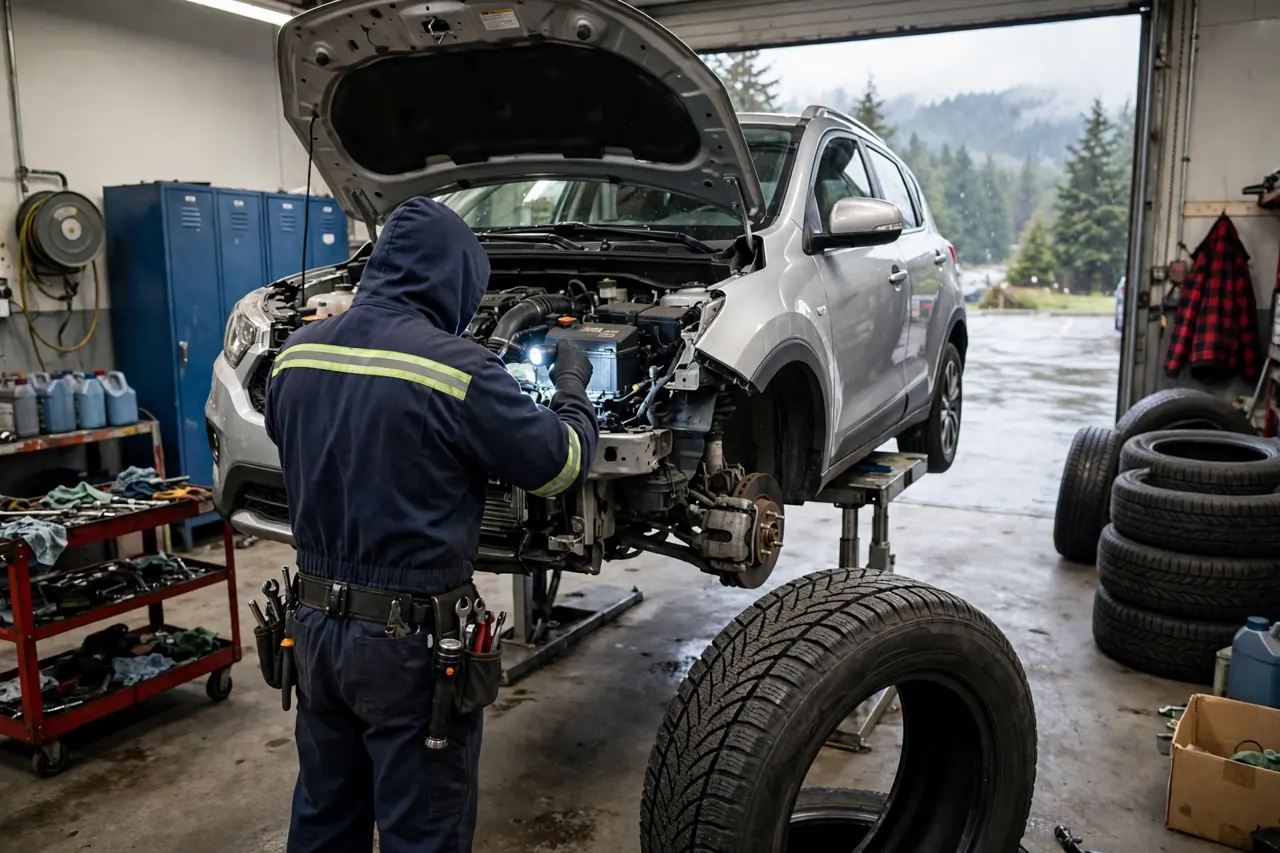
On a 2.0L car, check the oil level and condition before the test drive and again after — a low or filthy dipstick tells you about the previous owner’s habits, and oil use between services is worth screening for on any higher-kilometre direct-injection engine. On a 1.6L turbo car, the dual-clutch test above is the main event: spend ten minutes in slow traffic, not just on the highway. On any Tucson, run the VIN through the manufacturer’s recall lookup — this generation has had recall campaigns, and recall repairs are free at a franchised dealer. Ask for service records; a complete record is worth money.
History, declarations and the rebuilt question
A licensed BC dealer must declare in writing whether the odometer is accurate, whether damage repairs exceeded $2,000, and whether the vehicle was previously a taxi, police or emergency vehicle, rental or lease vehicle, or registered outside BC. Read those declarations, then read the history report the way our vehicle history report guide explains. If a car carries a rebuilt title — like our Tucson example — the disclosure should be specific and unhurried; our rebuilt title guide sets out our approach, and the price should reflect the history, as it does here.
The general used-car checks still apply
Work through brakes, tires, steering, suspension and electrics exactly as in our used car inspection checklist for BC. On an AWD Tucson, check that all four tires match in brand, size and wear — mismatched tires strain the all-wheel-drive system. Test the backup camera, heated seats and every power accessory, since these justify choosing a higher trim. On a higher-kilometre example, service history outweighs the odometer, as our high-kilometre buying guide explains.
Winter readiness in BC: AWD is not the whole answer
An AWD Tucson helps you get moving on a snowy morning in Langley; it does not help you stop. On the Province of BC’s designated winter tire and chain routes, winter tires are required from October 1 to April 30 — March 31 on select routes — for AWD vehicles exactly as for everyone else. A legal winter tire carries the M+S marking or the three-peaked mountain and snowflake symbol, with at least 3.5 mm of tread. Highway 1 through the Fraser Valley is not designated, but the Sea to Sky, the Coquihalla and Highway 1 east of Hope are. The full list is on the Province of BC designated routes page, and our winter AWD SUV guide covers the wider picture.
Running costs and the ownership picture
Fuel is the Tucson’s main running cost, and the engine decides it: at the 2.0L AWD car’s rated 10.1 L/100 km combined, 20,000 km a year uses about 2,020 litres, while a 1.6L turbo at 9.2 L/100 km uses about 1,840 litres — a gap of roughly 180 litres a year to weigh against the dual-clutch test. Run your own numbers with the method in our fuel-efficient commuting guide and our annual cost-to-own guide. Every vehicle we sell includes a 3-month warranty; the written terms for the specific car govern, so read them before you sign. If you plan to finance, our financing page explains how we work — and, plainly, WG Motors has no subprime or bankruptcy lender, and we do not promise rates or approvals. A trade-in can reduce the tax on your next vehicle; our sell and trade page is the starting point.
Conclusion: buy the powertrain and the paperwork, not just the price
A used Hyundai Tucson rewards a careful buyer: choose the third generation, pick between the simple 2.0L, the economical but dual-clutch 1.6L turbo and the later 2.4L with your eyes open, verify the declarations, history report and recall status, and budget for proper winter tires. If that sounds like your next SUV, visit WG Motors Ltd. — Dealer #50238 — at 19677 Willowbrook Dr, Langley, BC V2Y 1A5, Monday to Saturday, 11am to 6pm, and test drive our Tucson example. Start with our current inventory, review financing, or reach us through our contact page. Drive With Confidence.