
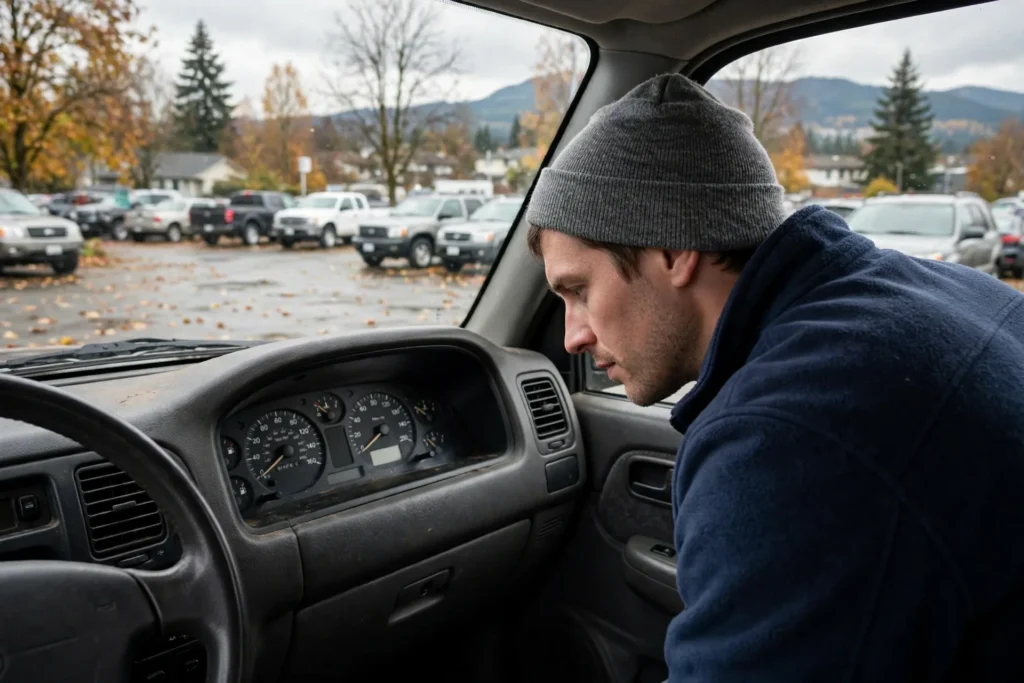
Every used-car shopper has a number in their head — the odometer reading where they stop scrolling. For some it is 150,000 km; for others, anything past 200,000 km is an automatic no. The honest answer to how many kilometres is too many for a used car: there is no fixed line. Buying a high kilometre used car in BC can be a smart way to get a lot of vehicle for the money, or an expensive mistake — and the difference is rarely the number itself. It is how those kilometres were driven, how the car was maintained, and what you check before you buy.
Start with kilometres per year, not the headline number
The odometer mixes two different things: how far the car has travelled and how old it is. Separate them. Divide the kilometres by the vehicle’s age and you get a much more useful picture. A car showing 240,000 km after twenty years has averaged about 12,000 km a year — gentle, ordinary use spread over a long life. A five-year-old car showing the same 240,000 km has averaged close to 50,000 km a year, which points to very heavy use, possibly commercial, and deserves much harder questions. The same logic works in reverse: a low reading on an older car is not automatically good news. Vehicles that sit unused can suffer dried seals, tired rubber, corroded brake parts and a neglected battery. Age wears rubber, hoses, belts and fluids on a calendar whether the car moves or not, while distance wears the parts that move — engine, transmission, suspension, brakes and tires. Weigh both clocks, not just the bigger number.
How the kilometres were driven matters as much as how many
Steady highway driving is the gentlest kind of use: the engine stays fully warm, speeds are constant, and braking and gear changes are few. Short city trips are the hardest: the engine may never reach full operating temperature, and stop-and-start driving works the brakes, transmission and suspension constantly. Two cars with identical readings can therefore be in very different shape. You cannot always know a car’s past use for certain, but you can read the clues — wear on the driver’s seat, steering wheel and pedals should honestly match the reading, and the service records should show a believable pattern. Wear that looks far heavier than the kilometres claim is a reason to slow down and verify, not to negotiate harder.
The paperwork: history, records and the dealer’s declarations
On a high-kilometre car, documents do the heavy lifting. Ask for service records and look for the pattern that protects an engine: regular oil and filter changes, cooling-system care, brake and tire work done on time, and large scheduled jobs completed rather than deferred. A vehicle history report adds the timeline — registrations, inspections and recorded odometer readings that should climb steadily, never drop or jump; our guide to reading a vehicle history report in BC walks through each section. Buying from a licensed BC dealer adds a layer a private sale does not: as the Vehicle Sales Authority of BC explains, the dealer must declare in writing whether the odometer accurately records the true distance travelled, whether the vehicle sustained damage costing more than $2,000 to repair, any prior use as a taxi, police, emergency, rental or lease vehicle, and whether it was ever registered outside BC — and must disclose anything else material to your decision, including rebuilt status.
The high-kilometre inspection checklist
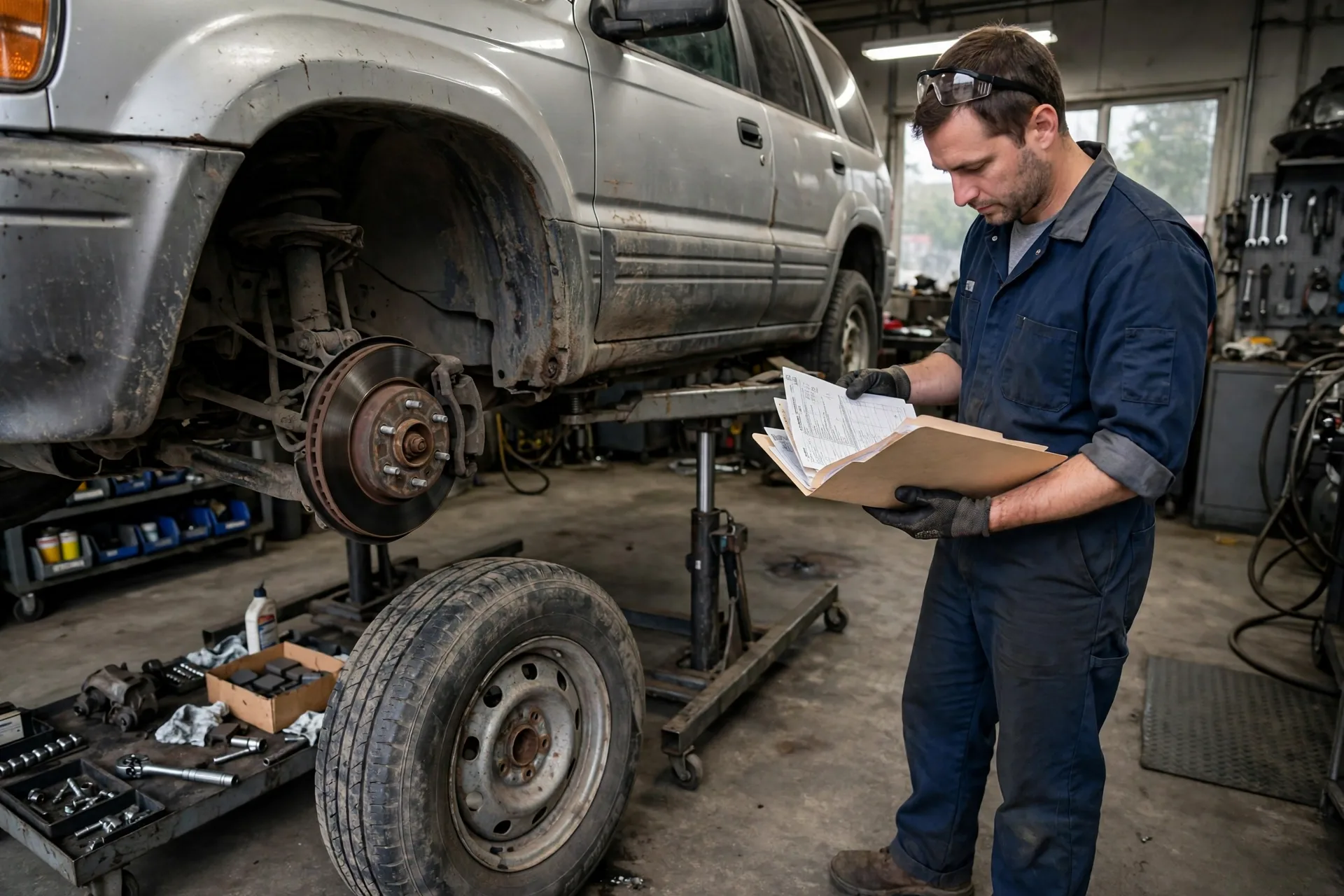
Our full pre-purchase inspection checklist for BC covers any used car; on a high-kilometre example, weight these items most heavily:
- Cold start and idle. Start the engine from cold. Knocking, heavy rattling, a hunting idle or blue smoke are warnings; a smooth, quiet cold start on a well-serviced engine is a good sign.
- Transmission. Shifts should be prompt and smooth, with no slipping, flaring or harsh engagement — transmission work is one of the largest bills a high-kilometre car can present.
- Suspension and steering. Knocks over bumps, vague steering, leaking dampers or cracked bushings are where high kilometres honestly show — budget for wear items rather than being surprised by them.
- Brakes and tires. Check pad and disc condition and tire age as well as tread. On designated BC winter routes, qualifying winter tires are required from October 1 to April 30 on most routes, with the M+S or three-peaked mountain and snowflake marking and at least 3.5 mm of tread.
- Fluids and cooling. Clean oil at the correct level, healthy coolant and no leaks. A neglected cooling system is a classic way an older engine gets damaged.
- Belts, hoses and rubber. These age with time as much as distance — cheap to find, expensive to ignore.
- Interior honesty. Seat, wheel and pedal wear should match the odometer. A cabin that looks twice as old as the reading is a question, not a detail.
The money math: a lower price only helps if you keep a reserve
High kilometres lower the price — that is the entire appeal — and the saving is real money you can hold back for maintenance. Run the all-in figure before you judge. At a BC dealer, a passenger vehicle under $55,000 carries 7% PST plus 5% GST under the Province’s Bulletin PST 308, charged on the price plus fees such as our $499 documentation fee. Worked through on our 2005 Honda CR-V EX at $5,750: $5,750 plus the $499 documentation fee is $6,249, plus 12% tax of $749.88, for $6,998.88 all-in before insurance. The discipline that makes this work is keeping part of the difference versus a lower-kilometre alternative as a repair reserve, instead of spending the whole budget on the purchase. Our guide to the yearly cost of owning a used car in BC shows how to build that reserve into a monthly budget, and our used car warranty guide explains the written protection to look for — every vehicle we sell includes a 3-month warranty.
Four live Langley examples, four different kilometre stories
- 2018 Mazda Mazda3 GS — rebuilt title, $9,995, 157,700 km: a 2.0L automatic sedan at roughly 20,000 km a year — the newest car here, with its kilometres earned in a shorter life. Its rebuilt title is disclosed upfront; ask us for its history before purchase, as with any rebuilt vehicle. See our rebuilt-title guide for how that status works in BC. View the 2018 Mazda3 GS listing.
- 2014 Honda CR-V EX — clean title, $15,990, 178,500 km: a 2.4L SUV at about 15,000–16,000 km a year — ordinary family use over eleven-plus years, and the kind of steady pattern the checklist above is designed to confirm. View the 2014 CR-V EX listing.
- 2015 Honda Odyssey — clean title, $13,990, 200,200 km: a 3.5L minivan past the 200,000 km mark at roughly 19,000 km a year. The questions that matter are transmission feel, seating wear, and documented maintenance — not the milestone number itself. View the 2015 Odyssey listing.
- 2005 Honda CR-V EX — rebuilt title, $5,750, 243,000 km: the highest reading on our lot, and the gentlest rate — about 12,000 km a year over two decades. Its listing discloses the rebuilt history plainly: front windshield only, repaired and inspected. At this age, rubber, hoses and the repair reserve deserve as much attention as the drivetrain. View the 2005 CR-V EX listing.
Browse the full used inventory in Langley — including the lower-kilometre vehicles in our guide to used cars under $15,000 in BC — and judge each one on condition, records and declarations, not on a single number.
When the right answer is to walk away
High kilometres are a reason to inspect carefully, not a reason to accept anything. Walk away from a car with no service history and a seller who cannot explain the gaps, an odometer story the documents contradict, a slipping transmission, a smoky cold start, or wear that plainly does not match the reading. Equally, do not let a tidy lower-kilometre car skip the same checks — neglect damages a parked car too. If you finance, approval and rates rest with the lender, and WG Motors has no subprime or bankruptcy lender.
The bottom line
How many kilometres is too many? The reading where the condition, the service history and the paperwork stop supporting the price — and that point is different for every car. Judge kilometres per year, how the vehicle was used, what the records and the dealer’s written declarations say, and what a weighted inspection finds — then keep a repair reserve, and a high-kilometre bargain can serve you for years. At WG Motors Ltd. in Langley (Dealer #50238), we disclose title status and history fully on every vehicle. See our financing page for how borrowing works, our sell or trade-in page if your current vehicle can lower the tax on the next one, or contact our team to book a test drive at 19677 Willowbrook Dr., Langley, BC, Monday to Saturday, 11 AM to 6 PM. Drive With Confidence.