
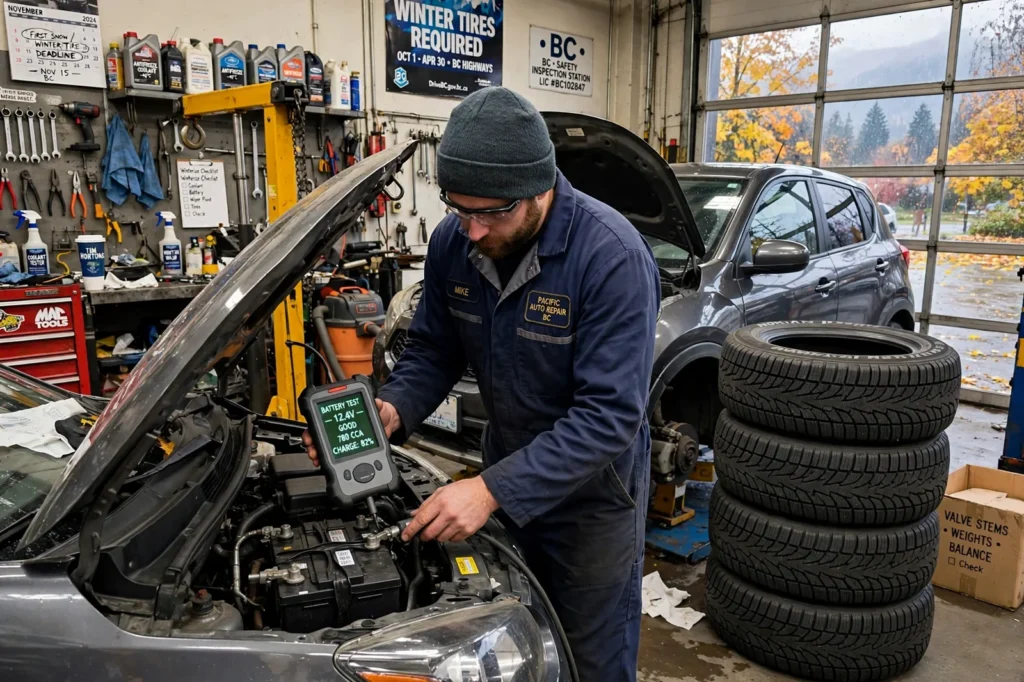
Winter in the Lower Mainland rarely announces itself politely. One week it is rain in Langley; the next, a cold snap ices the bridges, and a trip over the Coquihalla turns into a different season entirely. Knowing how to winterize your car in BC is mostly about timing: the checks below take an afternoon in November and are far harder at the roadside in January. If you bought a used car this year, treat this as your first-winter list — you inherited the previous owner’s maintenance, and winter is when the gaps show up.
Start with the law: BC winter tire rules
British Columbia’s winter tire requirement follows the road, not your address. On the Province’s designated winter tire and chain routes, passenger vehicles must use winter tires from October 1 to April 30 — on select lower-elevation routes the requirement ends March 31. A tire qualifies if it carries either the M+S (mud and snow) marking or the three-peaked mountain and snowflake symbol on the sidewall, is in good condition, and has at least 3.5 mm of tread. The rule applies to all-wheel-drive and four-wheel-drive vehicles exactly as it does to two-wheel drive: AWD helps you go, it does not change what the law requires or how you stop.
Many highways in the Lower Mainland and Fraser Valley are not designated because of the milder coastal climate — Highway 1 through Langley, Abbotsford and Chilliwack among them. But the designated network starts close to home: the Sea to Sky Highway to Whistler, Highway 1 east from the Hope area, Highway 3, and the Coquihalla are all designated routes. Driving a designated route without qualifying tires can mean a $121 fine and being turned back. Check the Province’s route list and DriveBC before any winter highway trip, and obey the posted signs where you drive.
Tires: aim above the legal minimum
Meeting the legal floor and being ready for a mountain pass are two different standards. M+S all-season tires are legal, but tires with the three-peaked mountain and snowflake symbol use a compound designed for cold, and winter-rated tires grip better once temperatures drop below about 7 °C — ordinary Lower Mainland winter temperatures. Fit four matched tires of the same type and size; mixing two winter tires with two worn all-seasons leaves the car unbalanced exactly when you need it predictable. Check pressures monthly: tire pressure falls roughly 1 psi for every 5 °C drop in temperature, and an under-inflated tire wears faster and handles worse. Do not forget the spare — a flat spare discovered in the snow is a second emergency. Our guide to the best used AWD SUVs for winter driving in BC covers how tire choice and drivetrain work together if you are also shopping.
Battery, starting and charging: the cold-snap failure
The most common winter breakdown is a battery that was fine in September. Battery power drops as the temperature drops, while a cold engine needs more effort to turn over — the two curves cross on the first hard frost. Have the battery load-tested before the cold arrives, especially if it is more than a few years old or its age is unknown (a fair question on any used car). Clean corroded terminals and make sure the cables are tight. A battery that tests marginal in November is a replacement decision, not a hope.
Fluids, belts and the cooling system
Winterizing fluids is quick and cheap:
- Coolant. The cooling system works as hard in winter as in summer — it also feeds your cabin heater. Have the coolant’s strength and condition checked; weak or neglected coolant risks both freezing damage and overheating.
- Windshield washer fluid. Drain the summer blend and refill with a winter formula rated for well below freezing — look for −30 °C or lower on the jug. You will use more of it in a week of slushy commuting than in a month of summer.
- Engine oil. If a change is due soon, do it before the cold season rather than after; clean oil at the correct grade helps cold starts.
- Belts and hoses. Cold makes old rubber brittle. Cracked belts and soft or swollen hoses found now are small bills; the same parts failing on a January highway trip are not.
Brakes, lights and seeing clearly
Short days mean most Lower Mainland commuting happens in the dark and the rain. Replace wiper blades that streak, chatter or leave arcs — on a wet Highway 1 night, wipers are safety equipment, not a consumable to stretch. Test every exterior light: headlights, brake lights, indicators and reverse lights, and clean the lenses. Have the brakes inspected if there is any noise, vibration or pulling; stopping distances grow on cold, wet pavement, and you want full braking in reserve. Before every winter drive, clear snow and ice from the whole vehicle — windows, lights, mirrors and the roof — not just a porthole in the windshield. Our pre-purchase inspection checklist covers most of these same items if you are still at the shopping stage.
Build the winter emergency kit
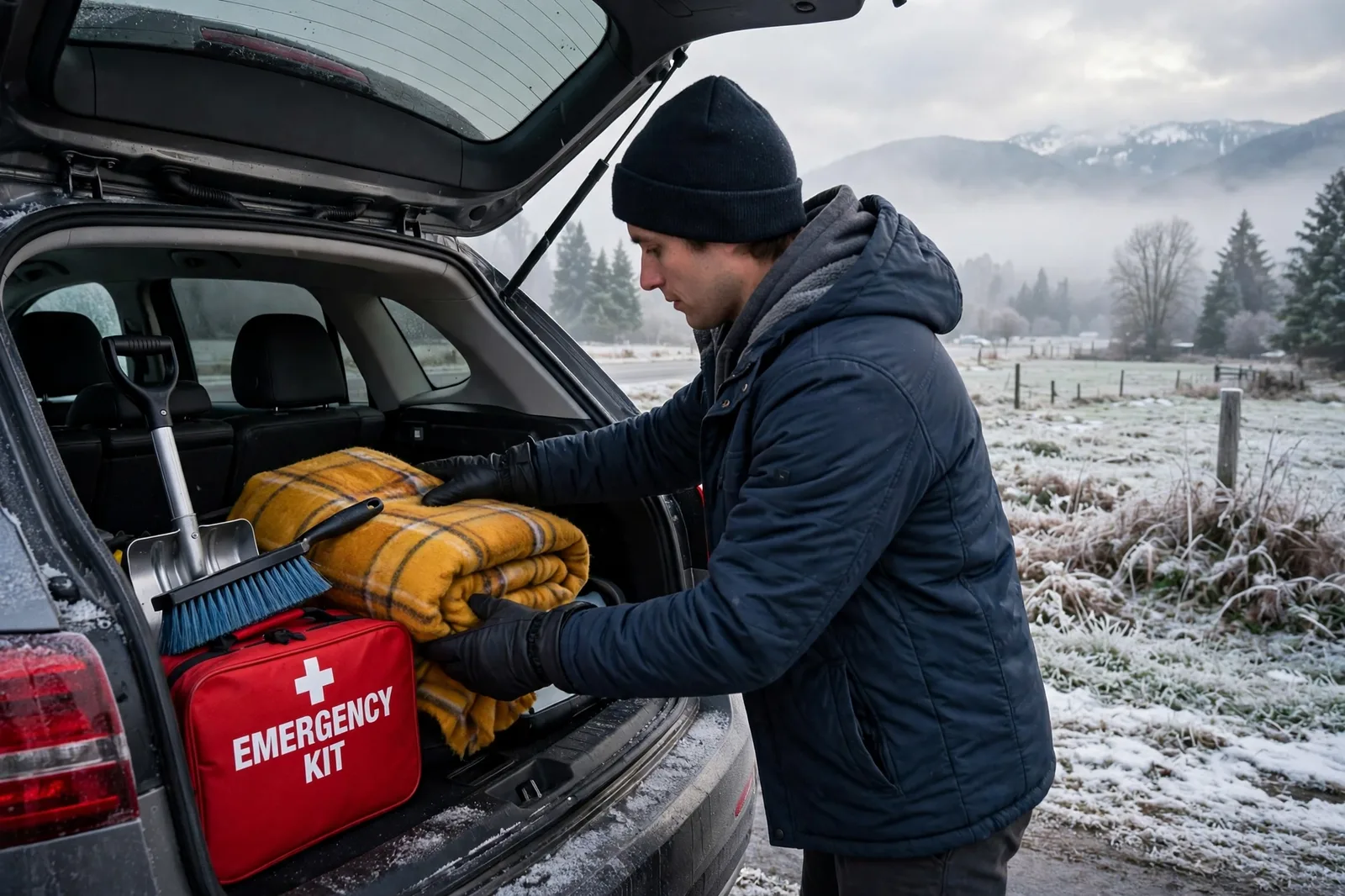
Road Safety at Work’s winter guidance for BC drivers recommends carrying an emergency kit and checking it every six months. A practical winter version for this province:
- Ice scraper and snow brush, and a small shovel
- Booster cables or a charged jump pack
- Warm blanket or sleeping bag, plus extra clothing — hat, gloves, warm footwear
- Flashlight with spare batteries, and reflective triangles or a high-visibility vest
- Non-perishable food (granola bars, trail mix) and bottled water
- First aid kit and a phone charging cable or power bank
- Sand, kitty litter or traction mats for getting unstuck
- Extra winter washer fluid
Keep the kit in a single bag in the trunk so it moves with the car, and tell anyone else who drives the vehicle where it is. If you drive a truck for work, our winter work truck checklist adds the payload, chain and job-site items that apply.
Extra checks on a used car facing its first winter with you
A car you have owned for years has a known history; a used car bought this year has unknowns, and winter exposes them. Confirm the battery’s age and test result, the coolant’s condition, the age of the tires as well as their tread (rubber hardens with age even when tread remains), the spare’s pressure, and whether the records show the brake and fluid work actually done. When you bought from a licensed BC dealer, the written declarations in your paperwork — damage repairs over $2,000, prior taxi, police, rental or lease use, out-of-province registration, odometer accuracy — tell you part of that story; the checks above tell you the rest. Our guide to the yearly cost of owning a used car in BC shows where seasonal maintenance belongs in the budget.
If your current car is not the right winter car
Sometimes winterizing honestly means admitting the vehicle itself is the problem — two-wheel drive on worn tires at the end of its reliable life, on a commute that now includes a designated route. Three winter-ready examples on our Langley lot as of today:
- 2014 Volkswagen Tiguan 4Motion — clean title, $10,490, 82,300 km: all-wheel drive in a compact SUV at a budget price, and the lowest kilometres here. View the 2014 Tiguan 4Motion listing.
- 2019 Honda CR-V Touring — clean title, $27,995, 57,900 km: the newer, lower-kilometre choice, with all-wheel drive for Fraser Valley winters and mountain trips. View the 2019 CR-V Touring listing.
- 2021 Mazda CX-5 AWD — rebuilt title, $22,249, 42,500 km: rebuilt status disclosed in full, as on every vehicle we sell: the front bumper and left headlight were replaced and the hood repainted, with no structural damage. All-in at our lot, $22,249 plus the $499 documentation fee is $22,748, plus 12% tax of $2,729.76, for $25,477.76 before insurance. View the 2021 CX-5 AWD listing.
Browse the full used inventory in Langley for more winter-ready vehicles. Every vehicle we sell includes a 3-month warranty. If you plan to finance, approval and rates rest with the lender, and WG Motors has no subprime or bankruptcy lender. Trading in your current car can also reduce the tax on the next one — our sell or trade-in page explains how, and our financing page sets out how borrowing works.
The bottom line
Winterizing is a checklist, not a project: qualifying tires with real tread and correct pressure, a battery that has passed a test instead of a hope, healthy coolant and winter washer fluid, brakes and lights you have verified, and an emergency kit in the trunk. Do it in November and a BC winter becomes weather instead of risk. If you would like a second set of eyes on a vehicle, or you are shopping for something more winter-ready, visit WG Motors Ltd. (Dealer #50238) at 19677 Willowbrook Dr., Langley, BC — open Monday to Saturday, 11 AM to 6 PM — or contact our team to book a visit. Drive With Confidence.