
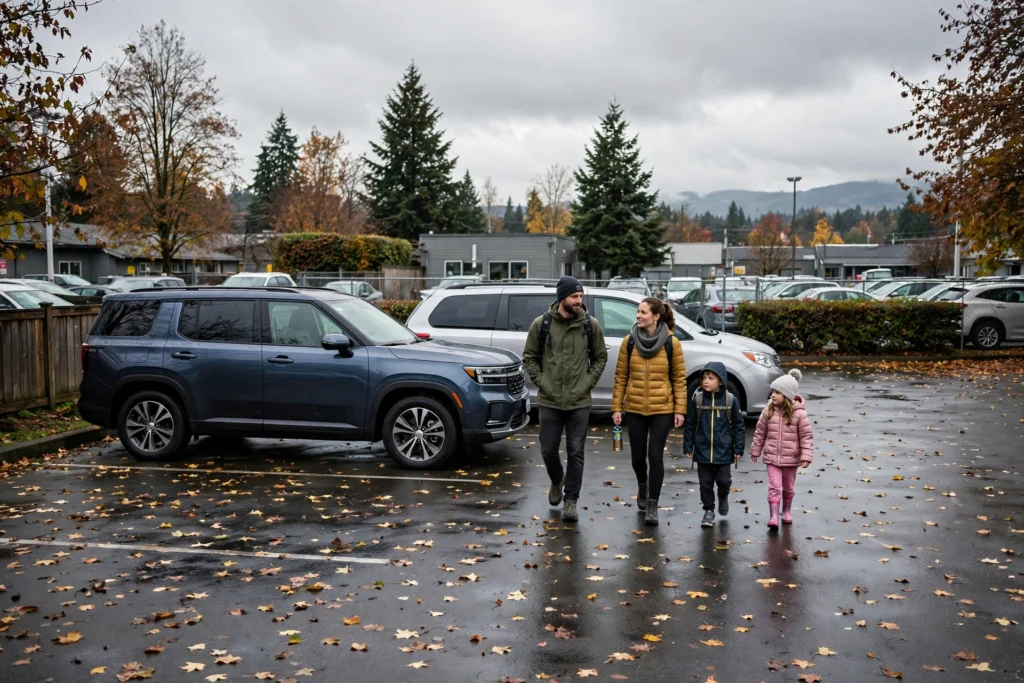
When a family outgrows a five-seat car, the search changes completely. You are no longer asking which vehicle is nicest to drive — you are asking where the third child seat goes, whether grandparents can ride along, and if a stroller, hockey bags and groceries can all fit at once. That is why used 7-seater vehicles in BC are among the most researched family purchases in the Lower Mainland. Three-row SUVs and minivans are not interchangeable, though. This guide explains how to choose between them, what BC law means for child seats, and what to check on a used example — with live Langley vehicles at real prices.
Three-row SUV or minivan? The honest trade-offs
A three-row SUV gives you a higher driving position, available all-wheel drive or four-wheel drive on many models, and styling most families prefer. A minivan counters with sliding rear doors that open in tight parking lots without dinging the car beside you, a lower load floor that makes lifting child seats and cargo easier, and usually the most usable third row in its price range — because a minivan is designed around its cabin.
Neither is automatically better. If your winter includes the Coquihalla or the Sea-to-Sky, a four-wheel-drive SUV on proper winter tires earns its keep. If your life is school runs and two child seats installed full-time, a minivan’s doors and floor height save effort every day. Minivans also often cost less than an equivalent-year SUV because they are less fashionable — exactly why value-focused families should not skip them.
Start with seats: who actually rides in the third row?
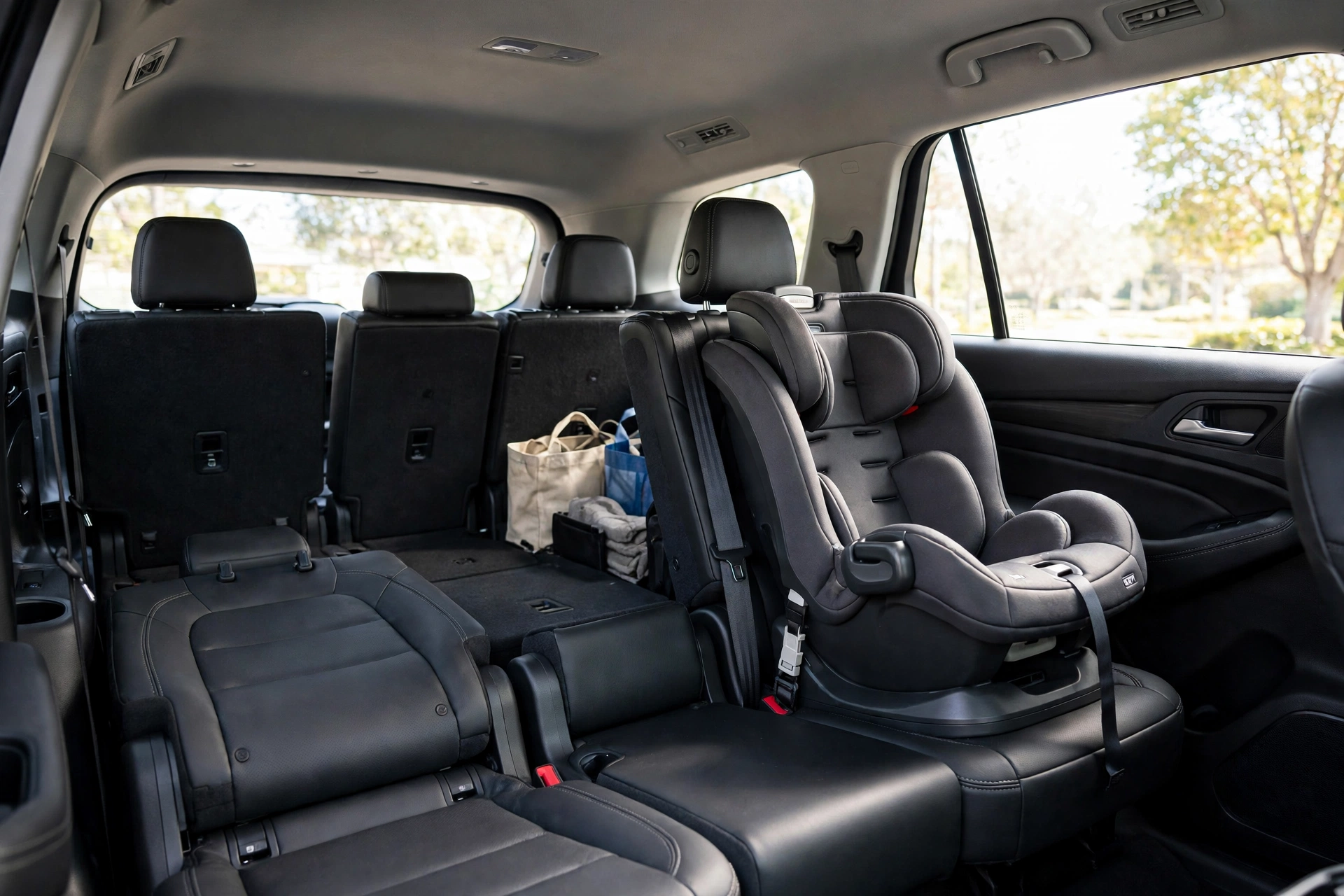
“Seven seats” on a listing can mean very different things. In some SUVs the third row is an occasional seat for a child on a short trip; in a minivan it is a genuine everyday row. Before comparing prices, answer three questions:
- How often will the third row be used? Daily use for teenagers demands real legroom and easy access. Occasional use after soccer practice is a much lower bar.
- Can an adult get back there? Climb in yourself. Check how the second row slides or folds, and whether a rear-facing child seat blocks third-row access completely.
- What is left for cargo with all rows up? Many three-row SUVs have a small cargo area behind the third row; minivans usually have a deep well instead. Bring the stroller you actually carry and load it.
Configurations vary within a model — seven or eight seats, or captain’s chairs — so confirm the count on the exact vehicle’s listing.
Child seats in BC: fit the vehicle to the law
British Columbia’s child restraint rules are staged, and they shape which vehicle works for your family. Under BC law, children ride rear-facing until at least one year old and 9 kg (20 lb), in a child seat until at least 18 kg (40 lb), and in a booster seat until their 9th birthday or until they reach 145 cm (4’9″) tall, whichever comes first. ICBC also recommends keeping children in the back seat as long as possible. A family with young children may need two or three restraint positions that work at the same time — for years.
So bring your child seats to the test drive and install them as you will use them. Confirm the anchors are reachable, that a third-row booster gets a proper lap-and-shoulder belt position, and that you can buckle a booster beside an installed convertible seat — centre seats are often narrower than they look. Our used car inspection checklist for BC covers the rest of the hands-on checks for that visit.
Cargo, doors and daily life in the Lower Mainland
Family vehicles earn their money in boring moments. Sliding doors need no swing clearance at a crowded lot, and children cannot fling them into a neighbour’s car. A low, flat load floor matters when the weekly shop, a folded stroller and a sports duffel all ride together. In an SUV, look at how flat the seats fold, whether the third row splits so a passenger and long cargo can coexist, and the lift-over height when loading in the rain.
Check the second row too: sliding seats let you trade legroom between rows trip by trip, and a row that tilts with a child seat installed is genuinely useful. Test every mechanism by hand — it should move smoothly, without forcing.
Winter, drivetrain and running costs
Drivetrain is the biggest running difference between the two camps. Most used minivans in BC are front-wheel drive, while three-row SUVs are commonly all-wheel drive or four-wheel drive. Front-wheel drive on proper winter tires is entirely workable for Lower Mainland commuting, but the law applies to everyone equally: BC requires winter tires or chains on most designated highways from October 1 to April 30 (March 31 on some routes), and a legal winter tire carries the M+S or three-peak mountain and snowflake marking with at least 3.5 mm of tread. The Province publishes the routes on its designated winter tire and chain routes page. Our guide to the best used AWD SUVs for winter driving in BC goes deeper on tire checks.
Expect a V6 three-row vehicle to use more fuel than a compact SUV — if your driving is mostly two-row commuting, our used Honda CR-V vs Toyota RAV4 comparison may save you money instead. Budget for tires in larger sizes, and confirm when the transmission fluid and, on all-wheel-drive models, the transfer case and rear differential fluids were last serviced.
What to check on a used three-row vehicle
- Every seat mechanism: fold, slide and tumble every row. Stuck third-row latches are common family-vehicle wear.
- Sliding doors (minivans): power doors should open and close fully from every switch and the key fob, without grinding or reversing mid-travel.
- Rear climate controls: run the rear heat and air conditioning on the test drive, and sit in the third row while you do.
- Title status and declarations: in BC a licensed dealer must declare, in writing, damage repairs over $2,000, prior taxi, police, rental or lease use, out-of-province registration and odometer accuracy. A rebuilt title must be disclosed up front — read our guide to buying a rebuilt title vehicle in BC before you judge one.
- Tires: mismatched or worn tires on a heavy family vehicle are an immediate cost, and tread near the 3.5 mm winter minimum means budgeting for a set now.
Five three-row choices in Langley right now
Live examples show the spread. At WG Motors today, verified on their listing pages:
- 2017 Dodge Journey SXT — $8,499, 123,000 km, clean title. Seven seats in three rows and a 3.6-litre V6 with 283 horsepower, front-wheel drive. The lowest-cost way into seven-seat ownership on our lot.
- 2016 Toyota Sienna LE — $12,750, 236,600 km, rebuilt title. A front-wheel-drive minivan with Toyota’s 3.5-litre V6 and sliding doors. The kilometres are high and the rebuilt status is disclosed on the listing — the price reflects both.
- 2015 Honda Odyssey — $13,990, 200,200 km, clean title. The classic family minivan formula: a 3.5-litre engine, sliding doors and a cabin built around passengers first.
- 2019 Ford Explorer XLT — $17,990, 66,000 km, rebuilt title. Seven passengers, four-wheel drive and a 3.5-litre V6 with 290 horsepower. Its listing discloses the rebuilt status and repaired left-side damage.
- 2020 Toyota Highlander XLE AWD — $34,995, 43,000 km, clean title. Three rows, a 3.5-litre V6 with 295 horsepower, four-wheel drive, leather and a sunroof — the low-kilometre, long-term family choice of the five.
Four of the five sit under $18,000; our guide to used cars under $15,000 in BC explains how to judge value at that level. Inventory changes quickly, so check the current used inventory in Langley before you visit.
The all-in cost: a worked example
Price the whole purchase, not the windshield number. Take the Journey at $8,499: add the $499 documentation fee for $8,998, and because a dealer passenger vehicle under $55,000 is taxed at 7% PST plus 5% GST in BC, the tax is $1,079.76 — an all-in total of $10,077.76 before ICBC insurance and registration. Every vehicle at WG Motors also includes a 3-month warranty. If you are financing, our financing page explains how approval works — approval and rates rest with the lender, and WG Motors has no subprime or bankruptcy lender. A trade-in can reduce the taxable amount; start with our sell or trade-in page.
The bottom line
The right used 7-seater fits your child seats, your third-row passengers and your cargo at the same time — minivans win on daily ease, three-row SUVs on winter drivetrains and choice. WG Motors Ltd. is a licensed Langley dealer (Dealer #50238) at 19677 Willowbrook Dr., Langley, BC, open Monday to Saturday, 11 AM to 6 PM. Bring your child seats, browse the current inventory, and contact our team to test drive the three-row vehicle that fits your family. Drive With Confidence.