
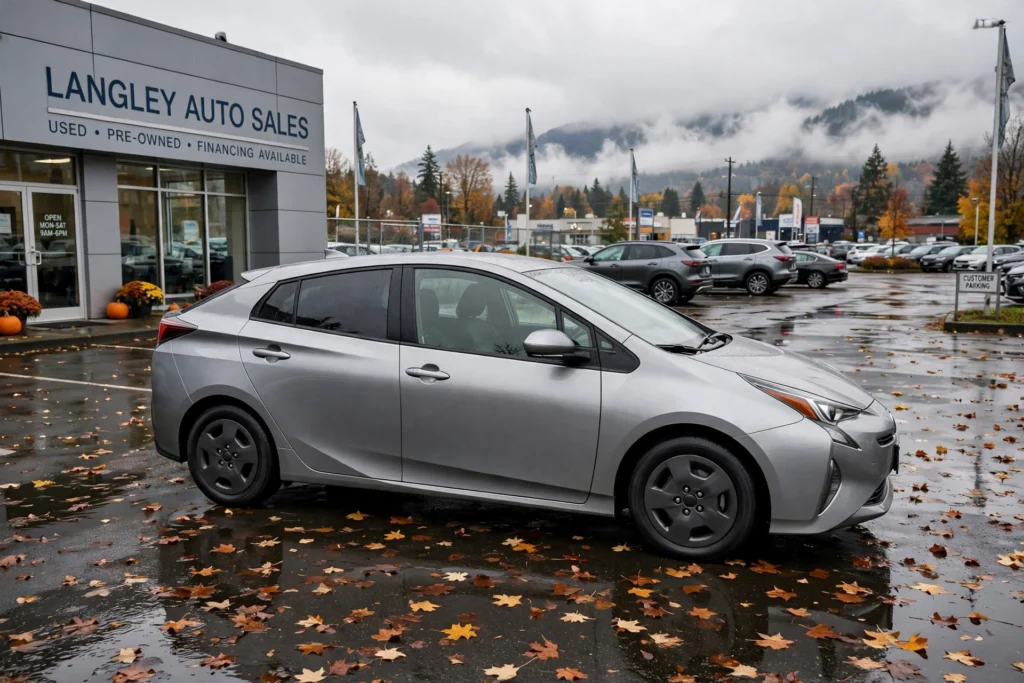
No used car raises the same question as a Toyota Prius: “but what about the battery?” It is a fair question — and it has a practical answer, which this used Toyota Prius buyer’s guide works through in order. The Prius has been on Canadian roads since the 2001 model year, it is front-wheel drive in almost every version you will find used, and the BC market holds everything from a high-kilometre third-generation car under $8,000 to the plug-in Prius Prime. The right buy depends on the generation, whether you can plug in, and on documented health checks for the individual car.
The generations at a glance
Four generations make up nearly everything on the BC used market today:
- Second generation (2004–2009): the car that made the Prius famous — a five-door hatchback with a 1.5-litre hybrid system. These are now the cheapest Prius you can buy, and at this age they are a condition-first purchase: buy the records and the inspection, not the badge.
- Third generation (2010–2015): a bigger 1.8-litre Atkinson-cycle engine with 134 net system horsepower, an electric motor and a continuously variable transmission. This is the value heart of the used market — affordable, modern enough, and built in the largest numbers.
- Fourth generation (2016–2022): a sharper redesign with better handling and lower fuel use again. Later cars also offered AWD-e, a small rear electric motor for low-speed traction — the only Prius versions that are not purely front-wheel drive. The plug-in Prius Prime belongs to this generation.
- Fifth generation (2023–present): a full redesign with all-wheel drive standard in Canada. Still nearly new, so used examples are priced accordingly.
For buyers shopping under $20,000, the third generation and the early Prius Prime are where the value sits — both examples at the end of this guide come from those two sweet spots.
Hybrid or plug-in? The Prius Prime explained
A regular Prius is a self-charging hybrid: you never plug it in, the battery charges from the engine and from braking, and you simply buy less fuel. A Prius Prime adds a plug and a much larger battery — 8.8 kWh on the 2017 car — so it can drive on electricity alone for roughly 40 km when new before the gasoline engine joins in. Toyota’s published figures rate the Prime at 1.8 Le/100 km on electricity and 4.3 L/100 km as a hybrid once the charge is used. Charging takes about two hours on a Level 2 charger, or about five and a half hours on a household outlet. If your commute fits that electric range and you can plug in at home, a Prime can go weeks between fuel stops; if you cannot plug in, the regular hybrid is the simpler buy. Our guide to buying a used electric car in BC covers battery health, home charging and the rebates that no longer apply to used purchases.
Fuel use: small numbers, honestly framed
Toyota Canada rated the 2014 Prius at 3.8 L/100 km combined — under the rating method of its day, which read lower than today’s five-cycle ratings, so treat it as a best case, not a promise. Age, cold weather, short trips and winter tires all push real-world use up. Even so, the arithmetic is compelling: at an assumed 5.0 L/100 km over 20,000 km a year, a Prius burns about 1,000 litres, against about 1,800 litres for a compact SUV at 9.0 L/100 km — a gap of roughly 800 litres, or about $1,280 a year at an illustrative $1.60 per litre. Our fuel-efficient cars guide shows how to run the same calculation with your own kilometres.
The hybrid battery: judge it by health, not by fear
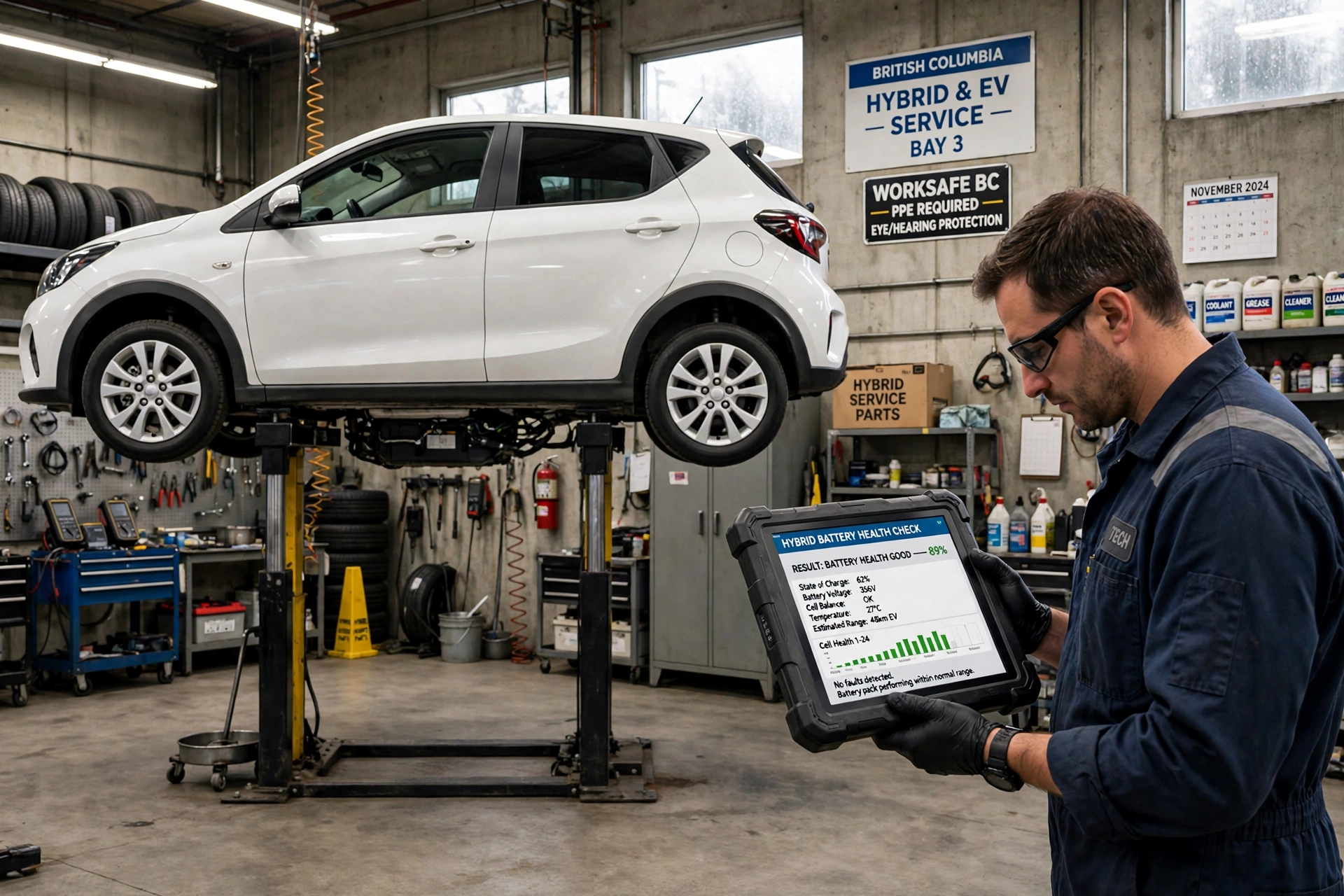
A Prius hybrid battery does not usually fail suddenly and completely, the way a dead 12-volt battery does. It fades. The warning signs are a fuel-economy drop, the gasoline engine running more often, and warning lights. That is why the single most useful step on any used Prius is a hybrid-system health check: a diagnostic scan reporting the battery’s state of health and any stored fault codes, done as part of a pre-purchase inspection. Do not assume any factory hybrid warranty remains on a car of this age — ask what, if anything, is left in writing, and let the health check do the protecting. Two supporting items matter too: the small 12-volt battery, which can cause confusing no-start symptoms when weak, and the battery cooling fan and filter, which need to be kept clean. A car with a clean health scan and a documented service file is a rational buy at almost any odometer reading — our high-kilometre buyer’s guide explains why.
Front-wheel drive in a BC winter
Almost every used Prius is front-wheel drive, and for most Lower Mainland driving that is enough — with the right tires. A hybrid’s low-speed electric torque helps gentle starts on slippery surfaces, but no drivetrain shortens a stop on ice. On the Province of BC’s designated winter tire and chain routes, winter tires are required from October 1 to April 30 (March 31 on select lower-elevation routes). A qualifying tire carries the M+S marking or the three-peaked mountain and snowflake symbol and has at least 3.5 mm of tread. Highway 1 through Langley is not a designated route — but the Sea to Sky, the Coquihalla and Highway 1 east of the Hope area are.
What to check on any used Prius
- Hybrid health scan: battery state of health and fault codes, as above — the headline check on a hybrid.
- Service records: regular oil changes, coolant services for the engine and the hybrid inverter system, and evidence the battery cooling fan and filter have been cleaned.
- Oil level and consumption: on a higher-kilometre third-generation car, check the oil level yourself and ask about consumption between services.
- Brakes: regenerative braking means the friction brakes work less, so check the discs for corrosion from underuse as well as for wear.
- The 12-volt battery: ask its age; a weak one is a common, inexpensive cause of strange electrical behaviour.
- Tires: tread depth, date codes, and whether they qualify for designated winter routes if your driving needs them.
- The paperwork: a BC dealer must declare in writing whether the odometer is accurate, any damage repairs over $2,000, prior taxi, police, emergency, rental or lease use, and any out-of-province registration. Read those declarations before you sign, cross-check them against the history report — our guide to reading a vehicle history report in BC shows how — and test drive the car using our used car inspection checklist for BC.
Two Prius examples on our Langley lot right now
These examples were live in our current used inventory when this guide was published. Prices exclude tax and the $499 documentation fee; every WG Motors vehicle includes a 3-month warranty.
- 2014 Toyota Prius — $7,775, 428,000 km, rebuilt title. The third-generation car: 1.8-litre hybrid, front-wheel drive, black hatchback. That odometer works out to roughly 35,000 km a year over the car’s life — exactly why the health scan and service file matter more than the number. Transparency: this car carries a rebuilt title, stated plainly on its listing, which invites you to discuss its history with us before purchase; no repair details are stated on the listing itself, so ask and we will go through what is documented.
- 2017 Toyota Prius Prime Technology — $16,690, 123,000 km, rebuilt title. The plug-in: 8.8 kWh battery, roughly 40 km of electric range when new, and the top Technology trim. Transparency again: this car is rebuilt because of a broken windshield only — the windshield was replaced and the car inspected, which is the full extent of its rebuilt history as we have verified it. A rebuilt title is a reason to read the history carefully, not to walk away by itself — our rebuilt title guide explains why.
The real number on the first car: $7,775 plus the $499 documentation fee is $8,274; as a dealer passenger vehicle under $55,000 in BC it carries 7% PST plus 5% GST, so tax is $992.88 and the all-in price is $9,266.88 before insurance and registration.
The bottom line
The Prius rewards a different kind of shopping: the decision is made by the hybrid health scan, the service file and the written declarations on the individual car. Choose the regular hybrid for simplicity, the Prime if you can plug in and your commute fits its electric range, and buy the checked car over the unchecked one every time.
WG Motors Ltd. (Dealer #50238) is at 19677 Willowbrook Dr, Langley, BC V2Y 1A5, open Monday to Saturday, 11 am to 6 pm — “Drive With Confidence” is how we do business. Browse our used inventory in Langley, see how financing works (we state plainly: WG Motors has no subprime or bankruptcy lender, and no rate is promised until a lender approves it), value your trade-in, or contact us to book a test drive.