

If you commute on Highway 1 — Langley to Burnaby, Surrey to Vancouver, Abbotsford into the valley — fuel is a bill you pay every week, and the difference between two similar-looking used cars can be a thousand dollars a year at the pump. This guide to fuel-efficient used cars in BC shows you how to read the official ratings honestly, how to run the math for your own commute, and which types of used cars actually save Highway 1 commuters money — with four live examples from our Langley lot.
Start with the rating — and understand what it is
Every vehicle sold in Canada carries fuel consumption ratings produced under Natural Resources Canada (NRCan) test procedures, published in the federal Fuel Consumption Guide. Three things about them matter to a used-car buyer:
- Lower is better, and the unit is litres per 100 kilometres. A car rated at 6.8 L/100 km combined will use roughly 6.8 litres to travel 100 km in the test cycle — about two litres less per 100 km than a car rated at 8.8.
- Ratings are a comparison tool, not a promise. NRCan’s tests are standardized so vehicles can be compared fairly; your real consumption moves with speed, congestion, cold weather, roof racks, tire choice and maintenance. Highway 1 stop-and-go is not the test cycle.
- Plug-in hybrids carry two numbers. A plug-in hybrid is rated in Le/100 km (litres equivalent) for electric driving and in ordinary L/100 km for hybrid driving once the charge is used. Which number describes your life depends on whether you can plug in at home.
Always look up the rating for the exact year, engine and transmission — the same model name can hide very different numbers. Our used car inspection checklist for BC covers the mechanical checks that sit alongside the rating.
Do the math for your commute, not the average driver’s
The formula is simple: annual kilometres ÷ 100 × combined rating × fuel price = annual fuel cost. Take a realistic Fraser Valley commute — 25,000 km a year, roughly a 100 km round trip five days a week — and an illustrative fuel price of $1.60 per litre (use today’s pump price in your own math):
- A plug-in hybrid running in hybrid mode at 4.3 L/100 km uses about 1,075 litres a year — roughly $1,720.
- An efficient gasoline compact at 6.8 L/100 km uses about 1,700 litres — roughly $2,720.
- The gap is about $1,000 a year — every year you own the car. Over a five-year ownership, that is real money toward insurance, tires or the next vehicle.
Run the same math at your actual distance: at 10,000 km a year that gap is worth only about $400, while at 35,000 km it is about $1,400. This is also why our first-car guide for BC tells new drivers to budget total running costs, not just the sticker.
Which type of commuter car fits which Highway 1 driver
- Plug-in hybrid — best if you can charge at home. If your one-way commute is within the car’s electric range and you plug in nightly, most of your driving is electric and your fuel bill collapses toward the Le/100 km rating. On longer days it simply behaves like a very efficient hybrid. The catch is the plug: without home or workplace charging, you carry a battery you never fill.
- Conventional hybrid — best if you cannot charge. No plug, no planning; the battery assists the engine and recovers braking energy — exactly the pattern of a congested Highway 1 commute.
- Small gasoline compact — the value pick. A 1.8–2.0L compact is usually the cheapest efficient option to buy, insure and repair, and its highway rating is often within sight of a hybrid’s.
- Midsize sedan — comfort costs a little fuel. A larger sedan rides quieter and carries five adults properly, but expect to give back roughly one to two litres per 100 km against a compact — a trade worth making only with your eyes open, using the formula above.
Four fuel-efficient examples on our Langley lot today
These vehicles were verified on our live used inventory in Langley today — prices and details are from each vehicle’s own listing page:
- 2017 Toyota Prius Prime Technology — $16,690, 123,000 km, rebuilt title. The plug-in option: a 1.8L plug-in hybrid with an 8.8 kWh battery, rated by NRCan at 1.8 Le/100 km in electric driving and 4.3 L/100 km in hybrid mode. Its rebuilt status is disclosed plainly, and the reason is on file: a broken windshield only, replaced and inspected — our rebuilt-title guide explains how to weigh that. This is the car behind the 4.3 L/100 km line in the worked example above.
- 2023 Toyota Corolla Hatchback — $21,499, clean title. The modern gasoline compact: a 2.0L engine with a CVT, rated at 6.8 L/100 km combined in NRCan-based figures. The hatchback body adds cargo room without the fuel penalty of an SUV.
- 2015 Honda Civic sedan — $14,250, 138,000 km, clean title. The budget commuter: a 1.8L engine with a CVT, rated at 7.9 L/100 km city and 6.1 L/100 km highway in Canadian figures. The all-in math at this price: $14,250 plus our $499 documentation fee is $14,749, plus 12% tax of $1,769.88, for $16,518.88 before insurance — the tax treatment follows BC’s Bulletin PST 308 (7% PST plus 5% GST on dealer passenger vehicles under $55,000).
- 2017 Ford Fusion SE — $12,995, 16,850 km, rebuilt title. The midsize comfort pick: a 1.5L EcoBoost turbocharged engine (181 hp) in a five-seat sedan with exceptionally low kilometres for its year. Its listing discloses the rebuilt title plainly — minor body damage, professionally repaired. You trade some fuel economy against the compacts above for space and quiet; run your own distance through the formula before deciding.
Every vehicle we sell includes a 3-month warranty. If you are comparing running costs more broadly, our guide to ICBC insurance and registration in BC covers the other half of the ownership bill.
Checks that protect a used car’s fuel economy
A rating describes the car when it was new. On a used car, these are the items that decide whether you still get it:
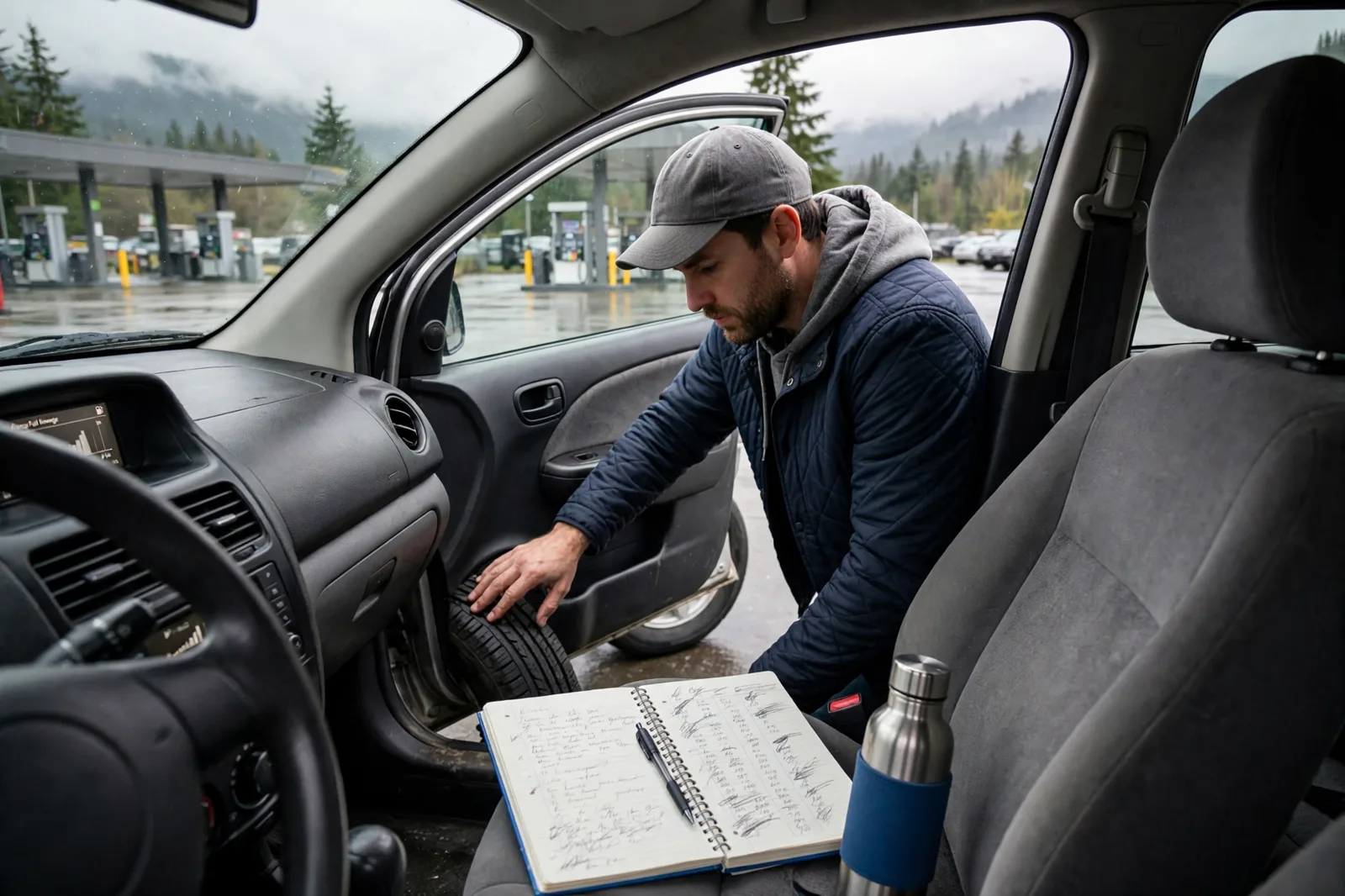
- Tires and pressure. Under-inflated or mismatched tires raise consumption and wear; check size, tread and pressure, and budget for proper replacements rather than the cheapest rubber.
- Alignment and brakes. A car that pulls, wears tires unevenly or drags a sticking brake is burning fuel to fight itself.
- Maintenance records. Fresh oil, a clean air filter and plugs changed on schedule keep a small engine efficient; gaps are a question to ask, and a vehicle history report helps you see the car’s past.
- Hybrid battery health. On a hybrid or plug-in hybrid, test-drive through a full electric-to-engine transition and check for hybrid-system warnings.
- A test drive on your actual route. Reset the trip computer, drive a Highway 1 stretch at your normal hour if you can, and compare the car’s own readout with the rating — it will not match exactly, and a large gap is information.
Winter on Highway 1: the Fraser Valley exception and the rule beyond it
BC’s winter-tire requirement applies on designated, sign-posted routes — most run from October 1 to April 30, with select routes ending March 31 — and a legal winter tire carries either the M+S marking or the three-peak mountain-and-snowflake symbol, with at least 3.5 mm of tread. Highway 1 through Langley, Abbotsford and Chilliwack is not itself a designated route, but continue east past Hope, up the Coquihalla, or onto Highway 99 toward Whistler and the requirement applies — so choose tires for the winter trips, not just the commute. The Province’s page on designated winter tire and chain routes lists every corridor. Our guide to used AWD SUVs for BC winter driving covers the other side of that decision.
The bottom line
For a Highway 1 commuter, the best choice is the car whose rating, multiplied by your real annual kilometres, leaves the most money in your pocket after the purchase price is counted. Look up the NRCan rating, run the formula at today’s fuel price, and check the items that decide whether a used car still delivers its rating. At WG Motors Ltd. in Langley (Dealer #50238), we will show you the history and inspection information for any vehicle on the lot. Financing questions? Our financing page explains how it works — approval and rates rest with the lender, and WG Motors has no subprime or bankruptcy lender. Bringing a vehicle of your own? Start with our sell or trade-in page — a trade-in can also reduce the tax on your next car. Visit us at 19677 Willowbrook Dr., Langley, BC, Monday to Saturday, 11 AM to 6 PM, or contact our team to book a test drive on your own commute route. Drive With Confidence.