
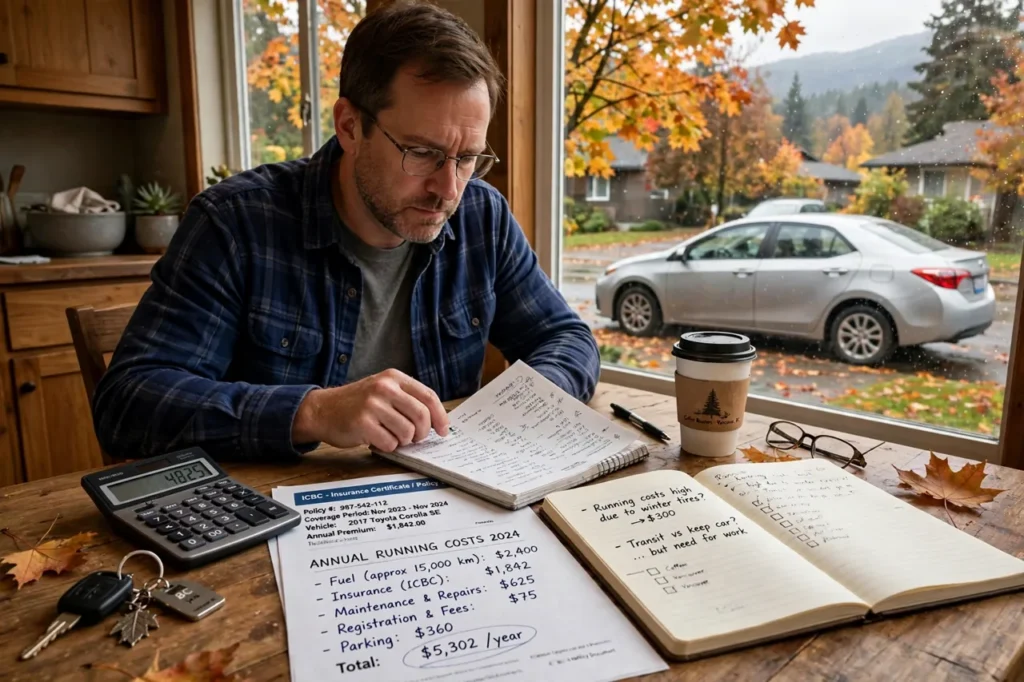
The purchase price is the number everyone shops by, but it is not the number you live with. The real cost to own a used car in BC is the purchase spread over the years you keep it, plus insurance, fuel, maintenance, tires and the repairs no used car completely avoids. Two cars with the same sticker price can differ by hundreds of dollars a year to run, and a cheaper car with high kilometres can cost more annually than a pricier one in better shape. This guide breaks the yearly cost into its parts, gives you the formula for each, and works through three live Langley examples.
The seven costs that make up a year of ownership
- Insurance and licensing. Paid every year, set largely by you and where you live — see below.
- Fuel or charging. The cost most directly set by how far you drive and what the vehicle uses per 100 km.
- Routine maintenance. Oil and filter changes, other fluids, filters, brakes and inspections, on the manufacturer’s schedule for that vehicle.
- Tires. A wearing item, plus a second set if your driving takes you onto BC’s designated winter routes.
- A repair reserve. Not a bill you can predict — money set aside so an alternator, a water pump or a suspension repair is an inconvenience, not a crisis.
- The purchase itself, spread out. Tax, the documentation fee, financing interest if you borrow, and the depreciation while you own it.
- Your personal extras. Parking, tolls, car washes and accessories — small, real, and entirely individual.
Add those seven together for a specific car, at your kilometres, with your insurance profile, and you have a number you can actually plan around. Our guide to used car financing in Langley covers the borrowing side in depth; this article covers the whole year.
Insurance: the cost you cannot copy from anyone else
ICBC does not publish a single average premium you can budget from, because under its driver-based model your premium is built from your own risk. As ICBC’s own cost page explains, the main factors are your driving experience (discounts build with each year, up to 40 years), your crash history, who else is listed to drive the car, the territory where the vehicle is kept — BC is divided into 14 territories — and how you use it, whether pleasure, commuting or business. The vehicle’s age, make, model and repair costs affect optional coverage, and choosing a higher deductible lowers the premium while raising what you would pay out of pocket in a claim. The practical lesson for a used-car budget: get a quote on the actual vehicles you are comparing, from an Autoplan broker, before you decide. The same driver can pay meaningfully different premiums on different cars, and a new or young driver will pay more than an experienced one for the identical vehicle — our ICBC insurance and registration guide walks through the paperwork and the 10-day registration deadline that come with it.
Fuel: the formula matters more than the rating
Fuel is the easiest cost to calculate honestly, because the formula needs only three numbers: annual kilometres ÷ 100 × litres per 100 km × price per litre. The consumption figure should come from the vehicle’s official rating as a starting point — ratings are standardized tests, so treat them as a comparison tool, not a promise. Take our 2015 Honda Civic sedan — clean title, $14,250, 138,903 km, whose 1.8L engine with a CVT was rated at 7.9 L/100 km in the city and 6.1 on the highway when new. If your driving averages 7.0 L/100 km and you cover 20,000 km a year, that is 200 × 7.0 = 1,400 litres; at an illustrative $1.60 per litre, about $2,240 a year. Run the same kilometres in a vehicle averaging 10.0 L/100 km and the bill is 2,000 litres, about $3,200 — a gap of roughly $960 a year, every year, from the consumption figure alone. Change the fuel price or your kilometres and the numbers move, which is exactly why the formula is worth more than any average. Our guide to fuel-efficient used cars for Highway 1 commuting applies the same math to high-kilometre commuters.
Maintenance, tires and the repair reserve
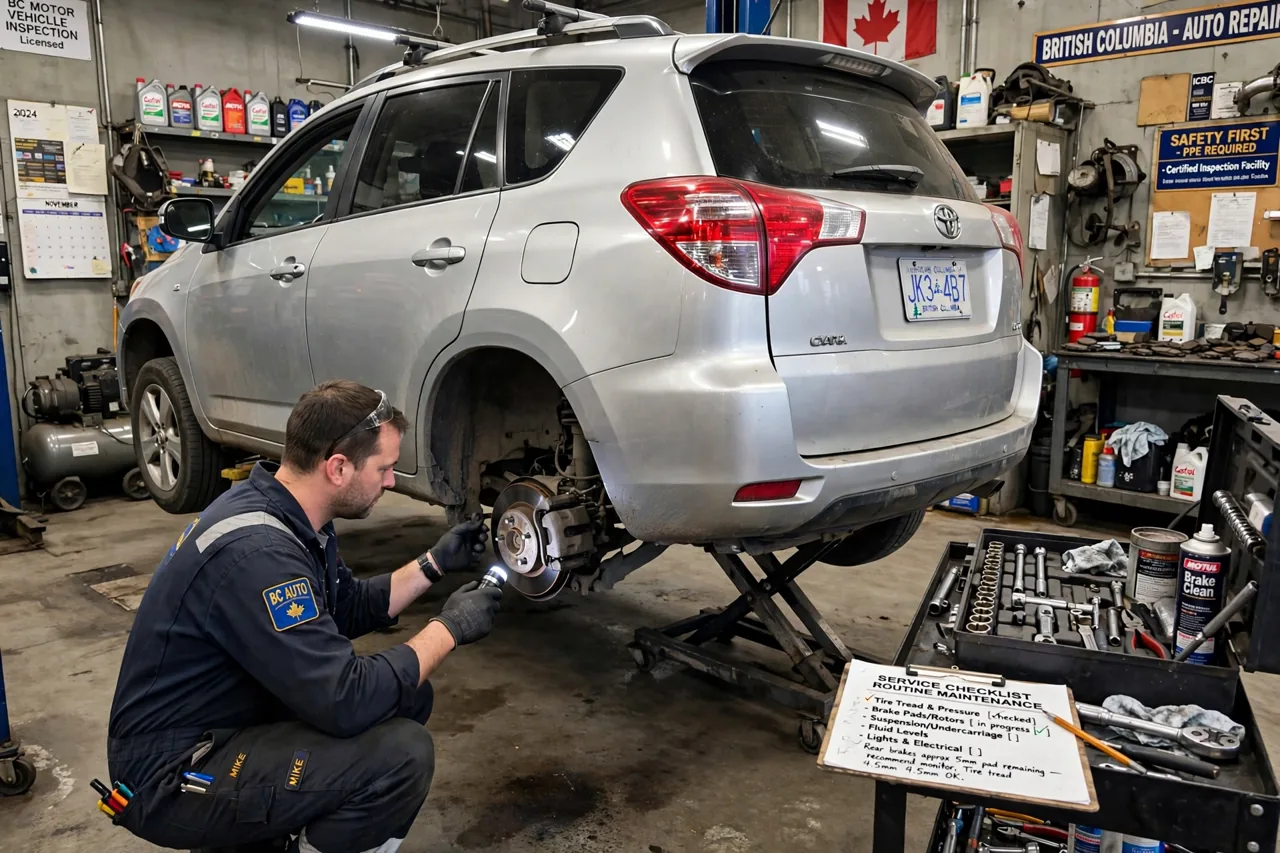
Routine maintenance follows the schedule in the owner’s manual for the specific vehicle — oil and filter changes, brake fluid, filters, and brake and tire wear that rise with the kilometres you drive. Budget it as a per-kilometre habit, not a surprise: money set aside each month beats a bill absorbed all at once. Tires deserve their own line. On designated BC winter routes, winter tires or chains are required from October 1 to April 30 on most routes (March 31 on select routes), and a qualifying tire carries the M+S or three-peaked mountain and snowflake marking with at least 3.5 mm of tread — if your driving includes the Coquihalla, the Sea-to-Sky or the Interior, a second set of tires is a real ownership cost, not an accessory. Finally, the repair reserve: every used car eventually needs work beyond its schedule, and the honest way to handle that is a monthly set-aside sized to the car’s age and kilometres. A low purchase price on a high-kilometre car is only a saving if you keep part of the difference in reserve. Our pre-purchase inspection checklist shows how to check the big wear items before you own them, and our used car warranty guide explains what written warranty protection does and does not cover.
The purchase, spread across the years you keep it
Ownership cost starts at the bill of sale. At a BC dealer, a passenger vehicle under $55,000 carries 7% PST plus 5% GST under the Province’s Bulletin PST 308, charged on the price plus fees such as our $499 documentation fee; a trade-in accepted by the same dealer reduces the taxable amount. Worked through on our 2016 Volkswagen Golf SportWagen — clean title, $10,990, 165,000 km: $10,990 plus the $499 documentation fee is $11,489, plus 12% tax of $1,378.68, for $12,867.68 all-in before insurance. Keep the car five years and that purchase works out to roughly $2,574 a year before running costs — keep it eight and the yearly share falls sharply, which is why how long you plan to keep a used car belongs in the decision. If you finance, interest is a real ownership cost on top of the price; approval and rates rest with the lender, and WG Motors has no subprime or bankruptcy lender. Depreciation matters too, in your favour here: a used car has already passed its steepest early drop in value, so the loss while you own it is usually gentler than on a new car — one of the main reasons the yearly math favours buying used.
Three live examples, three different budgets
- Lowest purchase, highest reserve: the Golf SportWagen above — $10,990, clean title, 1.8L wagon at 165,000 km. The cheapest way in, with the most kilometres of the three, so it deserves the largest repair reserve of the group.
- The commuter balance: the Civic sedan above — $14,250, clean title, 138,903 km. Its strength is the fuel formula: economical consumption, year after year, is worth real money to a Highway 1 driver.
- The family SUV: our 2014 Honda CR-V EX — clean title, $15,990, 178,500 km, a 2.4L SUV. Plan on SUV fuel consumption and tire sizes in your budget rather than sedan figures, and weight the reserve for its kilometres — the space and versatility are what the extra running cost buys.
None of the three is the “cheapest to own” in the abstract — each wins for a different driver, which is the point of doing the math per car. Browse the full used inventory in Langley and run the same seven lines on any vehicle you are considering. Weighing a rebuilt-title example? Our rebuilt-title guide explains that status honestly — we disclose it fully wherever it applies.
The bottom line
The cost to own a used car in BC per year is insurance you must quote on yourself, fuel you can calculate exactly, maintenance you can schedule, tires the province partly decides for you, a repair reserve you control, and a purchase price whose yearly weight shrinks the longer you keep the car. Add those lines before you fall for a sticker price, and the right car usually identifies itself. Every vehicle we sell includes a 3-month warranty. At WG Motors Ltd. in Langley (Dealer #50238), we will walk through the history and inspection information for any vehicle on the lot. See our financing page for how borrowing works, our sell or trade-in page if your current vehicle can lower the tax on the next one, or contact our team to book a test drive at 19677 Willowbrook Dr., Langley, BC, Monday to Saturday, 11 AM to 6 PM. Drive With Confidence.