
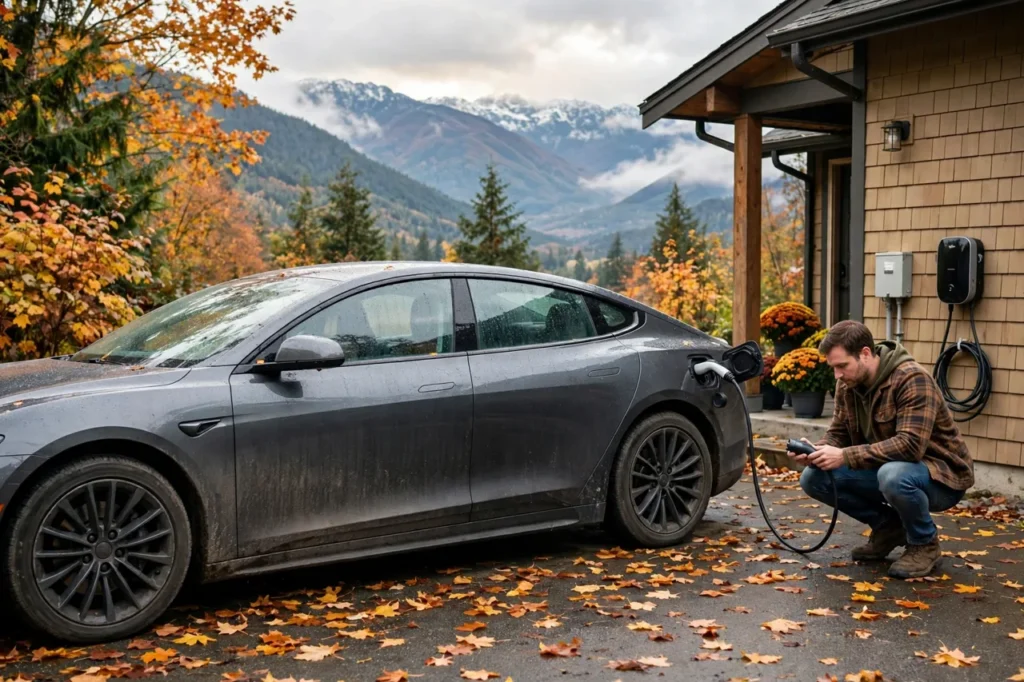
Buying a used electric car in BC is a different job from buying a used gasoline car. The motor has almost nothing to wear out, the fuel bill can drop sharply, and the questions that decide whether you bought well move to three places: the battery, the charging setup at your home, and the paperwork — including a rebate picture that has changed completely in the last two years. This guide works through all three, with the current rules stated as they stand in November 2026, and ends with two live electrified cars on our Langley lot, a battery-electric sedan and a plug-in hybrid, with their rebuilt histories disclosed.
First, know which kind of “electric” you are buying
- Battery-electric (BEV). No gasoline engine at all — a Tesla Model 3 is the common example. Running costs are the lowest, but every trip is planned around the battery and charging.
- Plug-in hybrid (PHEV). A smaller battery you charge from a plug, plus a gasoline engine for longer trips. A Toyota Prius Prime can cover short daily driving on electricity alone, then run as a hybrid when the charge is gone — no range anxiety, but two systems to maintain.
- Regular hybrid. Never plugged in; the battery only assists the engine. Efficient, but it is not an electric car in the charging or incentive sense, and it should not be priced like one.
The distinction matters for everything below: battery size, charging time, and which tax and rebate rules call the vehicle a zero-emission vehicle. Our Tesla lineup guide explains the battery-electric end of the market in more depth.
The rebate reality for used EVs in late 2026
Many used-EV ads still repeat incentive claims from a few years ago. As of today, for a used purchase in BC, the honest list is short:
- Federal rebate: new vehicles only. Transport Canada’s Electric Vehicle Affordability Program (EVAP), which replaced the old iZEV program, pays up to $5,000 on a new battery-electric vehicle and up to $2,500 on a new plug-in hybrid bought or leased on or after February 16, 2026, with a final transaction value of $50,000 or less for most vehicles. The program’s own rules require the vehicle to be new — registered for the first time — with only dealer demonstrators under 10,000 km also qualifying. A used EV does not qualify. The details are on Transport Canada’s EVAP overview page.
- BC passenger vehicle rebate: paused. The CleanBC Go Electric passenger vehicle rebate is officially paused and applications for pre-approvals are no longer being accepted — do not budget for it on any purchase, new or used.
- Used-EV PST exemption: ended. BC exempted used zero-emission vehicles from PST from February 23, 2022 to April 30, 2025. That exemption is over. A used EV bought from a dealer today is taxed like any other passenger vehicle in its price band — at the prices in this article, that means 7% PST plus 5% GST under BC’s Bulletin PST 308.
- One rebate that does still help: home charging. BC Hydro’s charger rebate covers up to 50% of the purchase and installation cost of an eligible Level 2 home charger, to a maximum of $350, for single-family homes, row homes and duplexes, applied for within 180 days of installation. See BC Hydro’s charger rebate page for the eligible-charger list before you buy one.
The conclusion is not that a used EV is a bad buy — it is that the saving now comes from the used price itself and the lower running costs, not from a government cheque. Price any used EV against that reality.
Battery health: the check that replaces the engine inspection
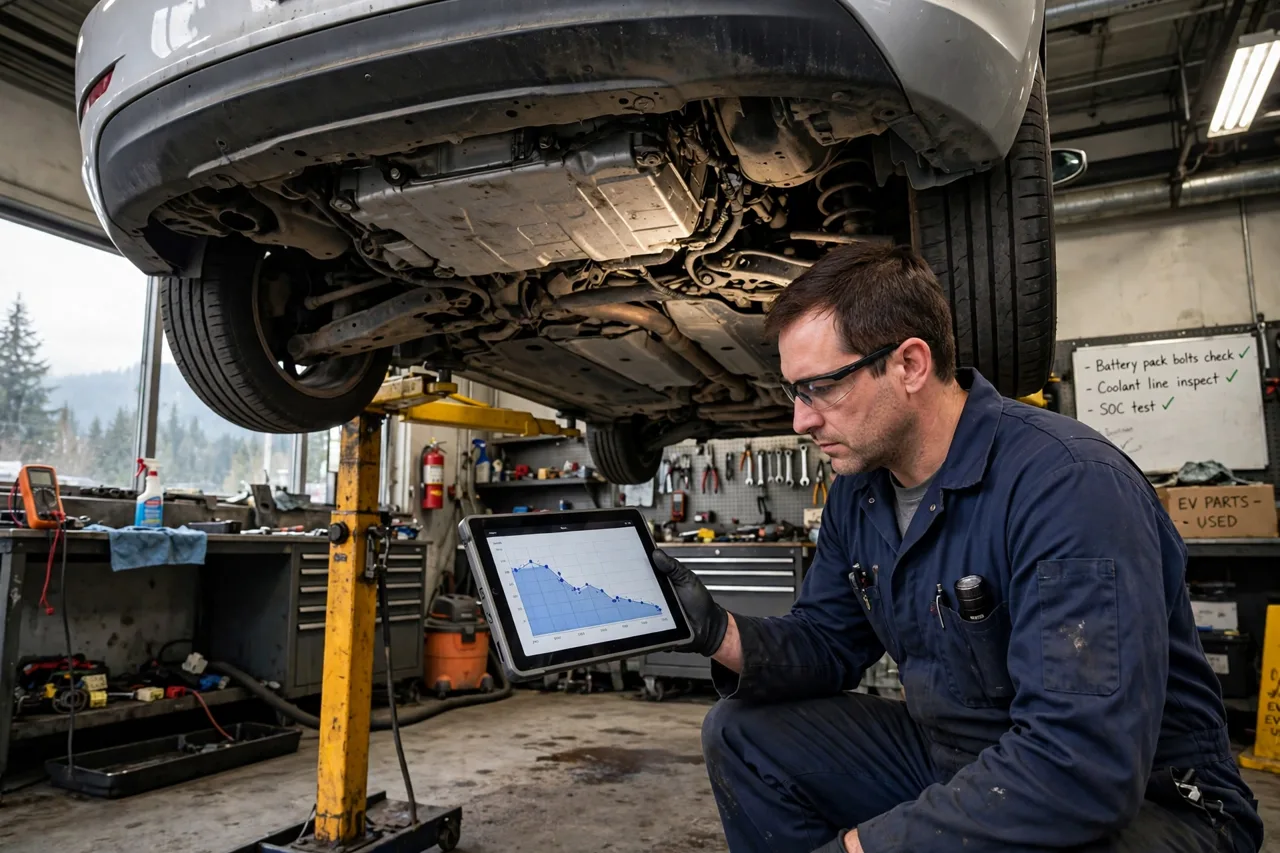
On a gasoline car you listen to the engine and look for leaks. On a used EV, the traction battery is the expensive component, and its condition — often called its state of health — decides the car’s real range and much of its value. Work through these checks:
- Charge it fully and read the range estimate. A 100% charge showing close to the model’s original rated range is a good sign; a large shortfall deserves questions. Treat the dashboard figure as an estimate shaped by recent driving and temperature, not a laboratory result.
- Ask for any battery health report and service records. Some models report battery capacity through dealer diagnostics or the car’s own screens. Records also show recall and software-update history, which matters on cars whose features and charging behaviour are updated over the air.
- Test both charging speeds. Confirm the car charges on a household outlet and, for a battery-electric, at a DC fast charger if you plan road trips. A car that will not fast-charge properly is a problem you want to find before you own it.
- Check what is in the trunk. The portable charging cable the car shipped with should be included; replacing one is an avoidable cost. Confirm the connector type matches the chargers you will actually use, or budget for the right adapter.
- Do not skip the ordinary car. Tires, brakes, suspension, the 12-volt battery and the cabin heater all still age normally — and EV tires can wear faster under electric torque. Our used car inspection checklist for BC covers the shared ground, and a vehicle history report still tells you the accident and lien story.
Charging at home and on the road
Natural Resources Canada describes three levels. Level 1 is a standard 120-volt household outlet, adding roughly 3 to 8 km of range per hour — slow, but genuinely workable for a plug-in hybrid’s small battery or a short commute. Level 2 uses a 240-volt circuit, like a dryer or oven, and adds roughly 16 to 97 km per hour depending on the vehicle and charger; it is the setup most battery-electric owners install at home, and the one the BC Hydro rebate above supports. Level 3 — DC fast charging — is the public highway network: the fastest option, priced per session, and meant for road trips rather than daily use. Before buying, be honest about your parking: a driveway or garage makes EV ownership easy, while a strata lot or street parking means checking your building’s rules and your nearest public chargers first. Cold weather also reduces range and slows charging, so a BC winter is the right assumption to plan around, not the exception.
Two live examples in Langley
Our 2022 Tesla Model 3 Standard Range — $22,490, 81,500 km is the battery-electric route: a single electric motor, five seats, and access to Tesla’s fast-charging network for highway trips. It carries a rebuilt title: our records show left-rear body damage that has been repaired, and we encourage a thorough inspection — our rebuilt-title guide explains how to weigh that status. The all-in math at this price: $22,490 plus our $499 documentation fee is $22,989, plus 12% tax of $2,758.68, for $25,747.68 before insurance — note that no PST exemption applies, exactly as explained above. Prefer the plug-in hybrid route? Our 2017 Toyota Prius Prime Technology — $16,690, 123,000 km pairs an 8.8 kWh battery (about 40 km of electric range when new, and a Natural Resources Canada rating of 1.8 Le/100 km) with a 1.8L hybrid system rated at 4.3 L/100 km once the charge runs out; it charges in about two hours on Level 2 or about five and a half on a household outlet. It is also a rebuilt title — in its case, per the history we have, a broken windshield only, replaced and inspected. Browse the full used inventory in Langley, and see our guide to fuel-efficient used cars for Highway 1 commuting for the gasoline and hybrid alternatives.
The bottom line
Buying a used electric car in BC in late 2026 means buying the car, not the rebate: check the battery like you would an engine, confirm your home charging before you fall for a car, and run the tax math with no exemption. Every vehicle we sell includes a 3-month warranty. At WG Motors Ltd. in Langley (Dealer #50238), we will show you the history and inspection information for any vehicle on the lot. Financing questions? Our financing page explains how it works — approval and rates rest with the lender, and WG Motors has no subprime or bankruptcy lender. Bringing a vehicle of your own? Start with our sell or trade-in page. Visit us at 19677 Willowbrook Dr., Langley, BC, Monday to Saturday, 11 AM to 6 PM, or contact our team to book a test drive. Drive With Confidence.